



Sambhdo! Sambhdo! Calico Printing 2 point thi vadhyu chhe, kone leva che? Calico Printing! Calico Printing!
The overlapping cries of brokers, buyers, sellers and spot boys once rose under a banyan tree opposite Mahurat Pol—Ahmedabad’s first Pol—in Manek Chowk. This was where Amdavadis learnt the art of speculation. Deals were struck on instinct, rough estimates, and whispered rumours, a practice locals called “Satto,” derived from “Adsatto” or the act of calculating an approximate value. Long before trading floors and ticker screens, somewhere around the late 1800s, this was the city’s informal first stock exchange, established with the intention of supporting local textile traders.
From the banyan tree to the ASE
The appetite for risk did not emerge overnight. During the Mughal era, traders in Ahmedabad actively bet on currency exchange rates, a practice later regulated by the administration. The opium trade brought its own cycles of speculation, followed by the textile boom, when mill shares became the city’s most coveted commodity. As joint-stock textile companies flourished, the market’s swings came to mirror the fortunes of the mills themselves.
This instinct, to speculate, to calculate risk, to wager on the future became inseparable from Ahmedabad’s commercial identity. Over time, what began beneath a banyan tree demanded order, structure, and space. Informal bets needed records; instinct needed rules.
In 1919, that transition from shouted deals in the open air to organised trading under a roof gave birth to one of India’s oldest financial institutions, embedded in the lanes of Manek Chowk: the Ahmedabad Stock Exchange (ASE).
Built for chaos
The choice of Manek Chowk was deliberate. For centuries, the area had been Ahmedabad’s commercial heart, including a vegetable market at dawn, jewellery bazaar by day, food street by night. Placing a modern financial institution here symbolically bridged the city’s traditional trading instincts with the emerging world of organised finance.
Originally established to trade textile stocks of local mills in Ahmedabad, the ASE started with informal operations in 1894, with the formation of the Ahmedabad Share and Stock Brokers Association. In 1919, it moved to the permanent heritage structure that we now see at Manek Chowk. Building India’s second-oldest stock exchange cost ₹3.6 lakh, an act that permanently secured Ahmedabad’s status as a premier national financial hub. Incidentally, the oldest stock exchange, the Bombay Stock Exchange (BSE) was founded in 1875.
In 1956, the ASE merged with other regional associations under the Securities Contracts (Regulation) Act, 1956. This further reinforced the city’s reputation as the “Manchester of the East,” a city unafraid of risk, speculation, and reinvention.
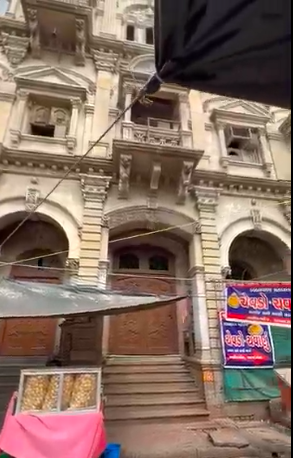
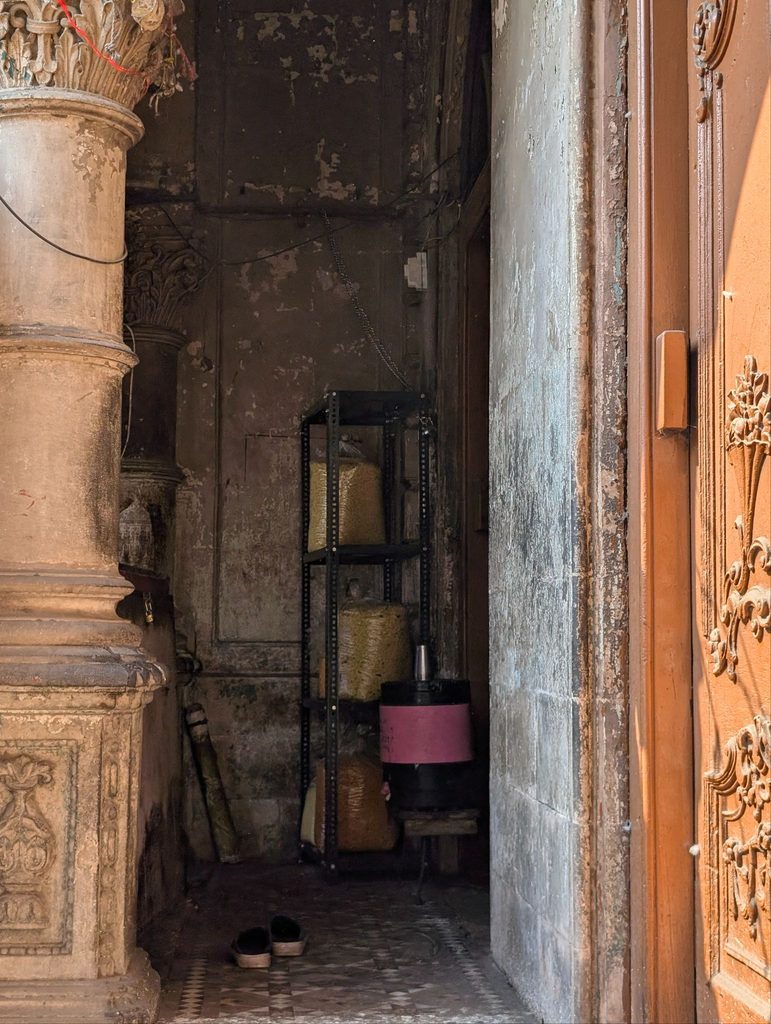
But today, as I walk through the busy lanes of Manek Chowk, I struggle to pinpoint the entrance to the building—once the gateway to fortunes. Instead, a farsan shop, Juna Sherbajar Chavanawada, almost as old as the building itself, several food stalls, a pani puri vendor’s supplies of potatoes, steel containers and plastic drum crowd the edges of the entrance.
Did you know?
So infectious was the trading instinct among Gujaratis that even the celebrated Gujarati poet Kavishwar Dalpatram reportedly fell prey to market speculation and suffered losses during the 1865 market crash—proof that the stock market bug spared no one. The poet turned to his dear friend and British administrator Alexander Kinloch Forbes for a loan of 1,000 rupees to get him out of the rut and wrote extensively, warning people about the perils of stock market speculations. Deepak Mehta writes at length about this incident in his book ‘Dalpatram Atle’.
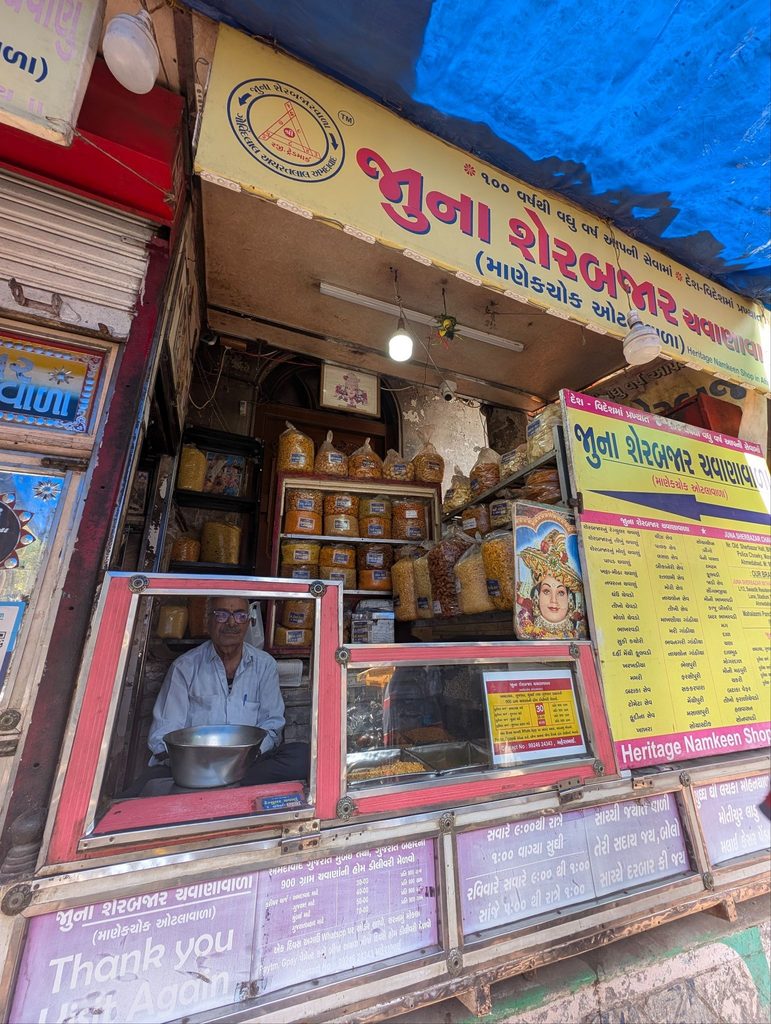
The owner of the farsan shop, who is a fifth generation entrepreneur, remembers the time when his grandfather shared stories about spot boys shouting share prices and stock names under the banyan tree right across the shop. “Amdavaad ni ane amari dukaan ni odakh che aa sher bajaar” (This building the identity of both Ahmedabad and our shop),” he says, with pride.
The majestic old exchange building still stands as a reminder that long before apps and algorithms, Ahmedabad learned the language of the market and spoke it loudly.
Grade I heritage site
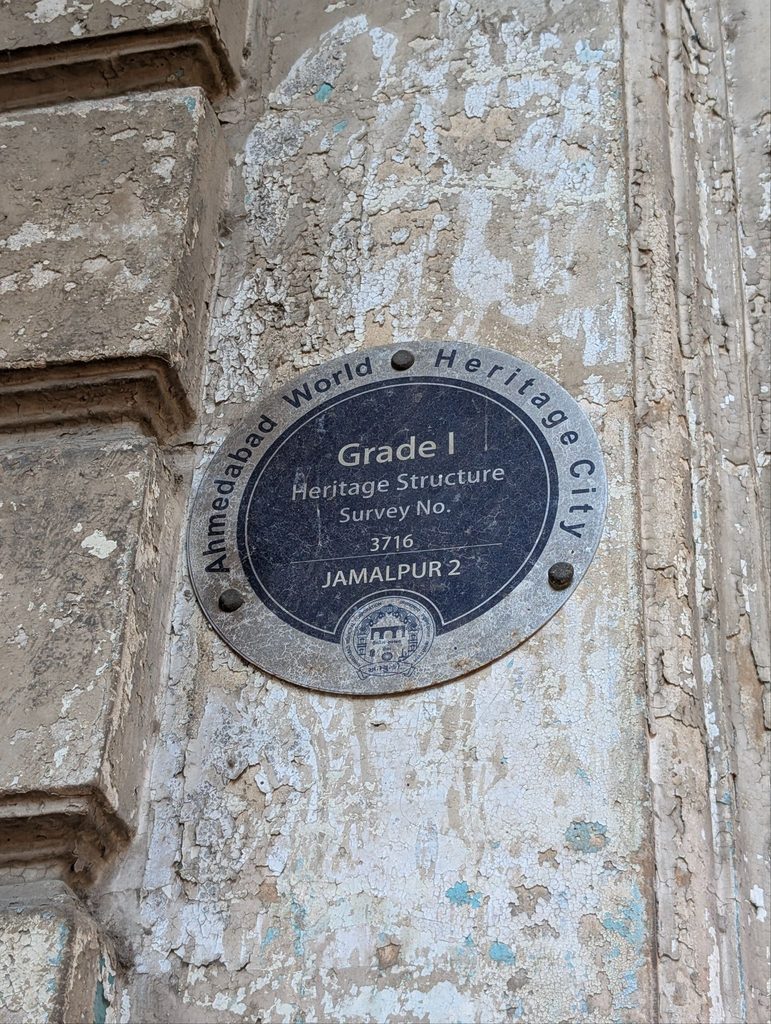
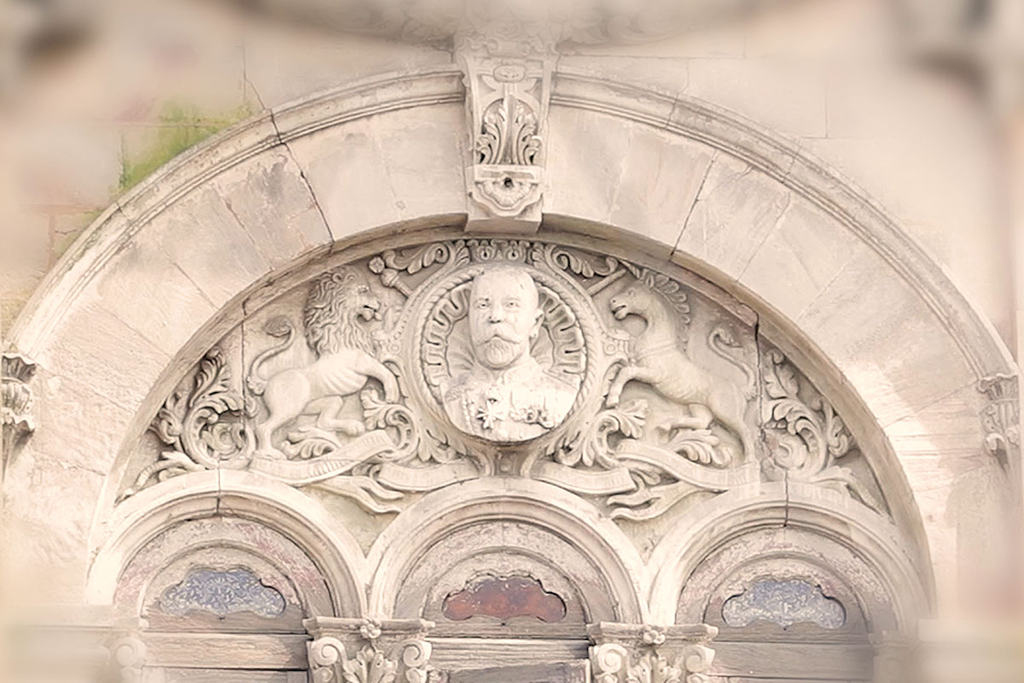
The three-storied building itself tells a story. European style columns merge beautifully with fine carvings on the yellow Dhrangadhra stone, giving the building its classic Neo-classical facade. Ornate wooden balconies overlook the chaos below. High ceilings and large windows allow light and air to flow freely, helping ventilate a floor once packed with shouting brokers. Inside is a vast central trading hall, which must have once echoed with the roar of open-outcry trading. The grand façade, carved with intricate detailing, blends seamlessly with the historic surroundings of Manek Chowk, including landmarks like Rani no Hajiro, Badshah no Hajiro and Jama Masjid.
Protected on paper
The paradox is striking: structures stamped with heritage status often end up frozen in time. They may be protected on paper, but are starved of regular maintenance or meaningful reuse. Across India, former financial and civic landmarks and historic buildings have been renovated, opened to the public, curated, and celebrated without compromising their character. Mumbai’s BSE heritage gallery, the restored Town Hall precincts, the old currency building in Kolkata’s BBD Bagh and London’s Royal Exchange have all shown us that this is possible.
“Heritage buildings should not be dismissed as entirely unrestorable just because they are in poor condition. While structural safety, seismic issues can present challenges, these can be systematically overcome with proper safety measures and intent,” says conservation and restoration architect Nirav Hirpara.
After all, these spaces do more than preserve bricks and mortar; they keep memory alive, allowing citizens to walk through history rather than merely look at it from behind barricades.
Yet, despite its historical weight, the old ASE remains locked to the public. There is currently no confirmed plan to restore or repurpose the building as a museum, cultural centre, or public space, even as discussions continue around the broader revitalisation of the Manek Chowk precinct.
For a city that once spoke the loudest language of trade and enterprise, the silent halls of the old ASE raise a larger question: Should heritage merely be safeguarded, or should it be lived, seen, and shared?